
AI Is Everywhere ... But It Hasn’t Made Internal Communications Easier
Judgment, relationships, and trust are still queen.
2026 survey of 500+ internal communications leaders
Automation has arrived. The hard parts of the job haven’t gone anywhere.
A year ago, Shallot surveyed internal communications leaders about how their work had shifted post-pandemic. This summer, we checked back in. AI has radically changed how these leaders and their teams work, with more than 85% running generative and agentic workflows daily and one-third of their organizations having someone formally assigned to AI ownership.
And yet AI hasn’t fixed the core friction of communicating with employees. Communicators still struggle to reach scattered teams, constant reorgs create fatigue, employees are drowning in noise, and internal announcements leak instantly. Even with their reliance on AI, leaders crave human solutions: executive access and cross-functional alignment.
The numbers to know
89% use generative AI regularly or extensively
85% use agentic AI regularly or extensively
33% have someone on the team with a job solely focused on AI
16% say their team is “leading the pack” on AI adoption
26% name reorganizations, restructuring and layoffs a top messaging priority
18% say AI itself is one of their biggest challenges
35% want better access to executive leadership
34% want better cross-functional collaboration
500+ U.S. communications leaders surveyed
AI automates the mechanics. Judgment, relationships, and trust are still queen. We see that as job security for internal comms leaders.
Finding 1: AI is now infrastructure in internal communications teams
No one debates whether internal communicators use AI anymore. Nearly 90% run generative AI regularly or extensively, including 43% power users. Agentic AI tools, which automate full workflows instead of just writing copy, stand at 85% adoption.
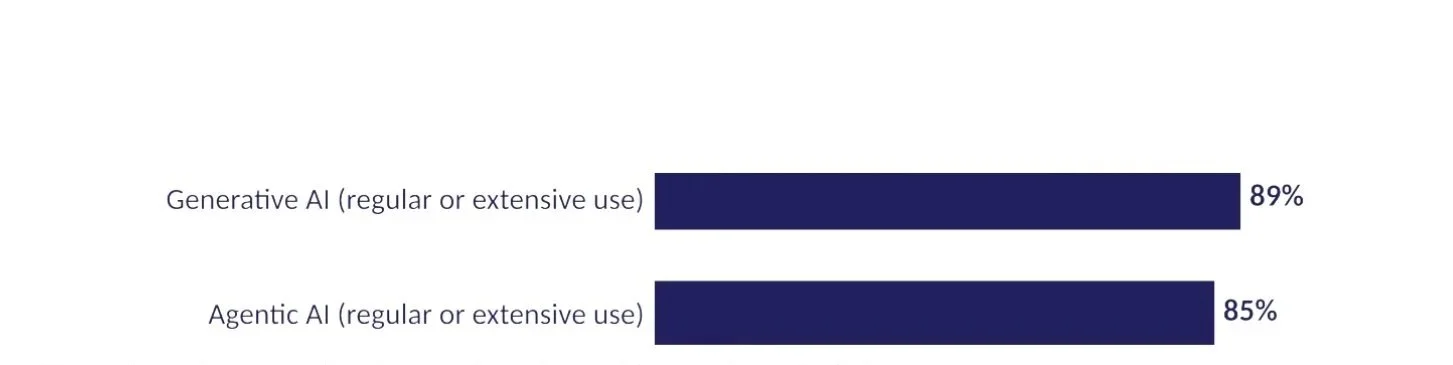
Share of internal communications leaders using each type of AI regularly or extensively.
The structure of teams is changing too
An internal leader who “owns” AI is the emerging trend. A third of teams (33%) have built a dedicated AI role inside internal comms, and another 49% have named an AI point person within existing roles.
Top AI use cases
Process automation leads all use cases at 33%, followed closely by visual content creation and content calendars (32% each). Search, summarization, exec comms and sentiment tracking now sit firmly in the standard toolset.
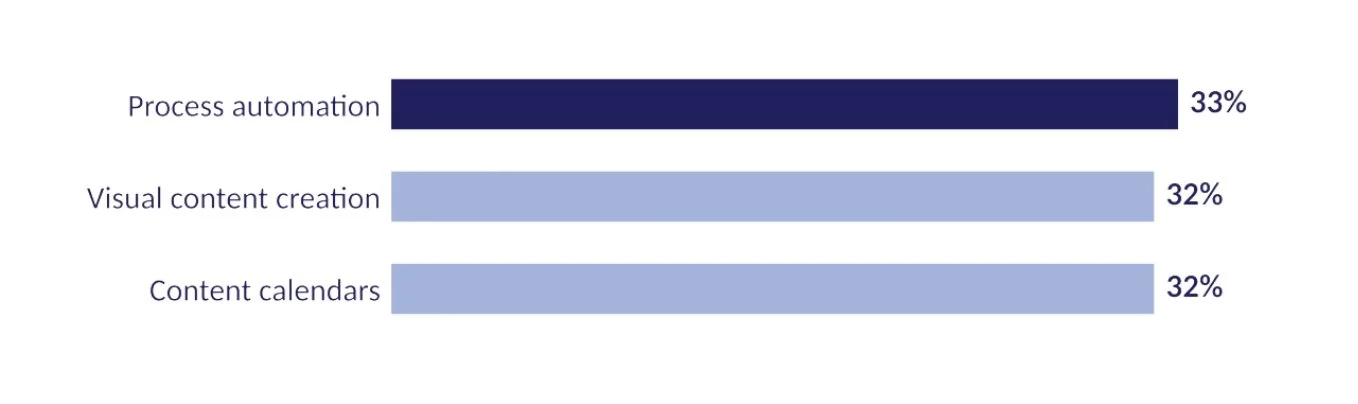
Top AI use cases: process automation, visual content creation and content calendars.
Where the expertise gap shows
Even with growing adoption, there is still an AI expertise gap within the field. Only 16% call themselves true AI leaders pushing the boundary edges.

How leaders describe their team’s AI adoption.
Resources matter
Deep pockets correlate with more experimentation and workflow re-engineering. Twenty-nine percent of respondents on teams with budgets of $500,000 or more describe themselves as AI leaders, compared with just 3% of those with budgets below $100,000. Larger teams and companies similarly report greater AI expertise.
Finding 2: A gender difference worth watching
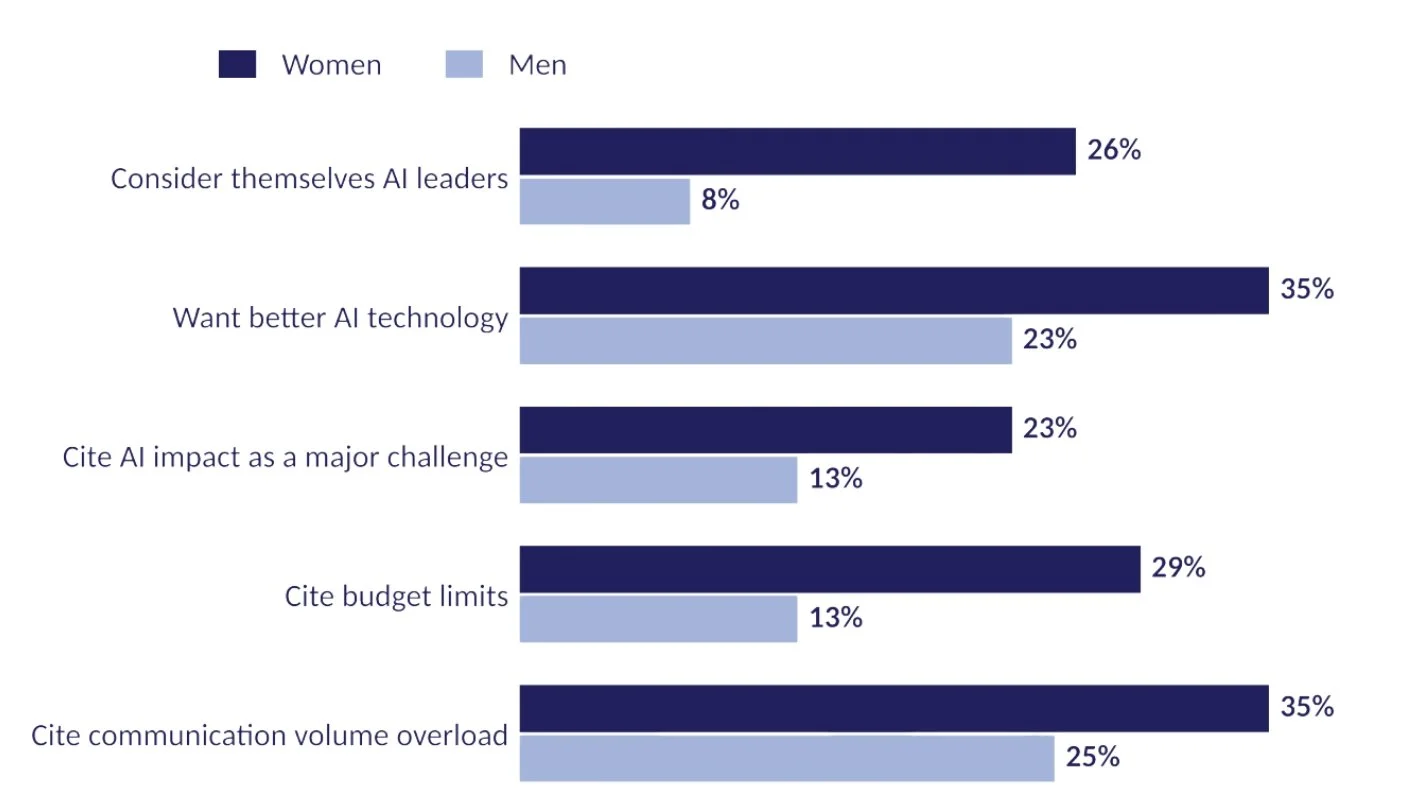
Female communications leaders are adopting AI at a more involved clip than their male counterparts. More than a quarter of women surveyed (26%) consider themselves AI leaders, compared to just 8% of men. Women report higher overall tool adoption and demand better AI tech at higher rates.
Survey-reported gender differences in AI leadership, technology needs and communications challenges.
Women also cite AI impact as a major challenge at higher rates, but stress that AI cannot replace human curiosity. They navigate steeper structural hurdles too: budget limits and communication volume overload.
Finding 3: Technology isn’t solving the hardest communications problems
Despite relentless AI headlines, leaders place AI low on their list of real operational headaches. Only 18% rank AI impact as a top challenge. Reaching remote staff stalls 33% of leaders, connecting with frontline workers limits 32%, constant organizational change strains 31%, and change fatigue drags down 30%.
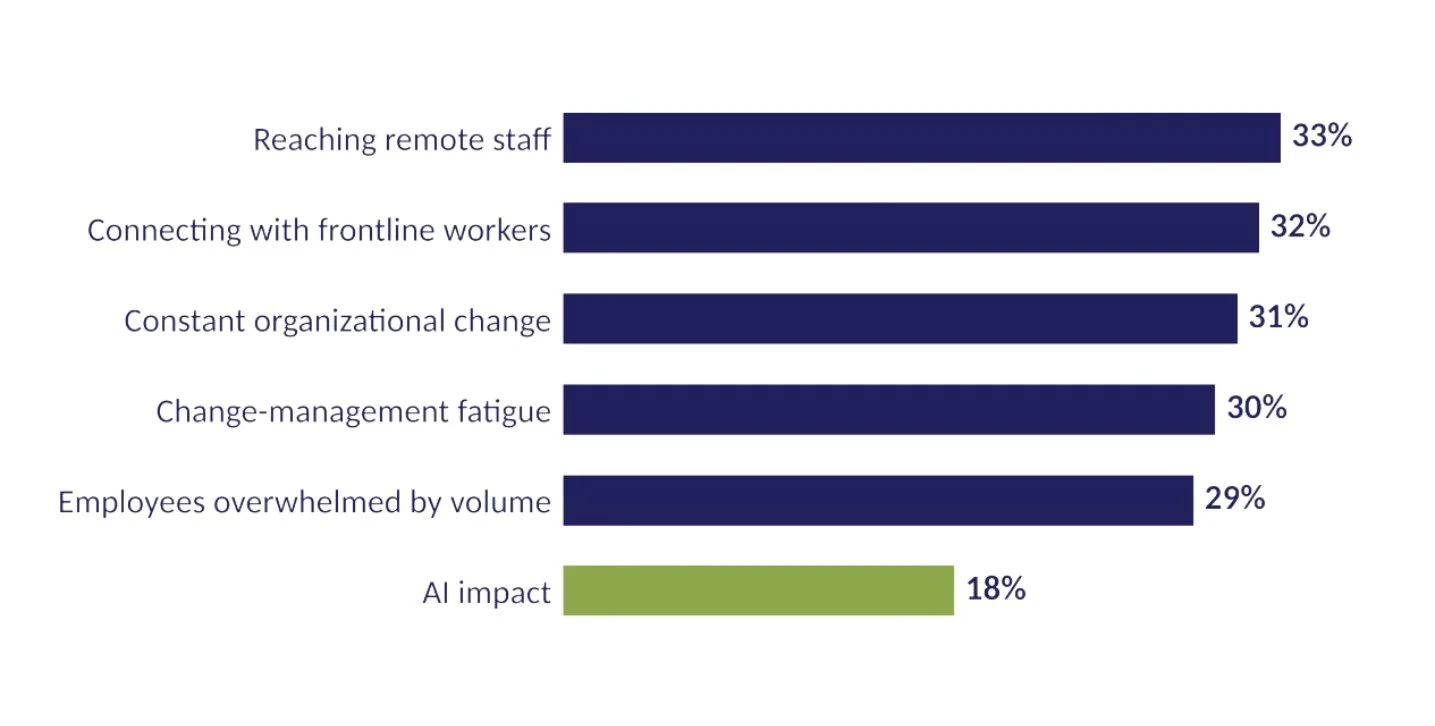
Top challenges named by internal communications leaders.
What’s on the wishlist
Information overload continues to be an issue, with 29% of leaders citing employees overwhelmed by the volume of communications. Top on the wishlist are better platforms, followed closely by direct executive access and cross-functional alignment.
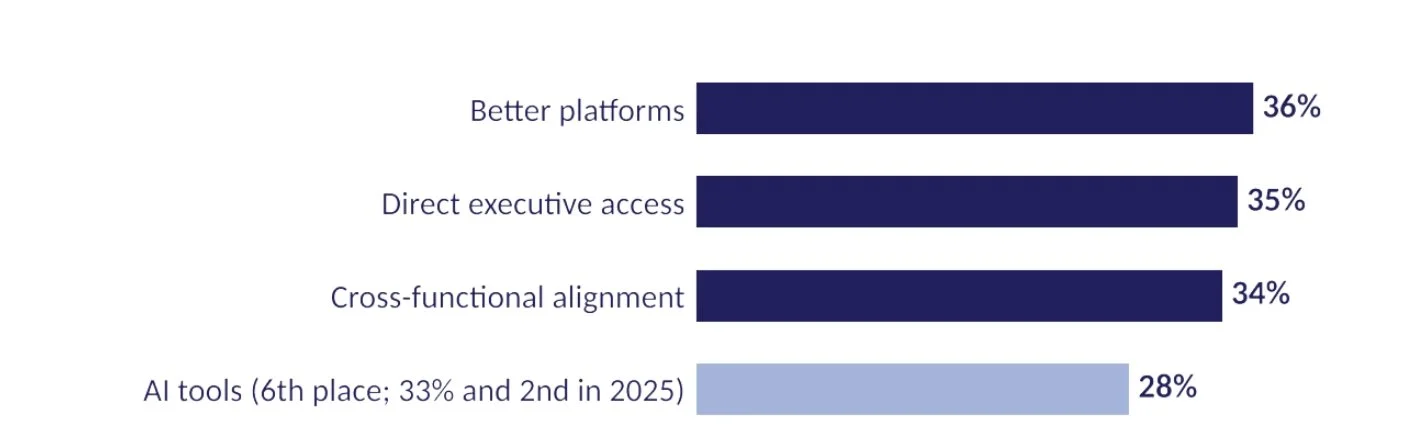
Top needs in 2026. In 2025, leaders named AI tools their second biggest need (33%); this year it dropped to sixth place (28%).
AI tools dropping down the wishlist doesn’t signal lost interest. It signals that AI has become ubiquitous.
Finding 4: Internal communicators are managing change, not just communications
Messaging priorities reveal corporate America’s immediate realities in 2026. The top focus is reorganizations, restructuring and layoffs, with AI enablement and workforce training a close second.
Top messaging priorities. Routine business performance updates fell 10 points year over year, from 30% in 2025 to 20%.
Financial metrics didn’t lose importance. We assume communicators absorbed a wider wave of structural change. Nearly a third identify the constant pace of change and uncertainty as a major challenge.
Finding 5: The more AI can do, the more the human parts of the job matter
We asked leaders directly: what is the one thing AI can’t automate that you feel most passionately about? There was no clear winner.
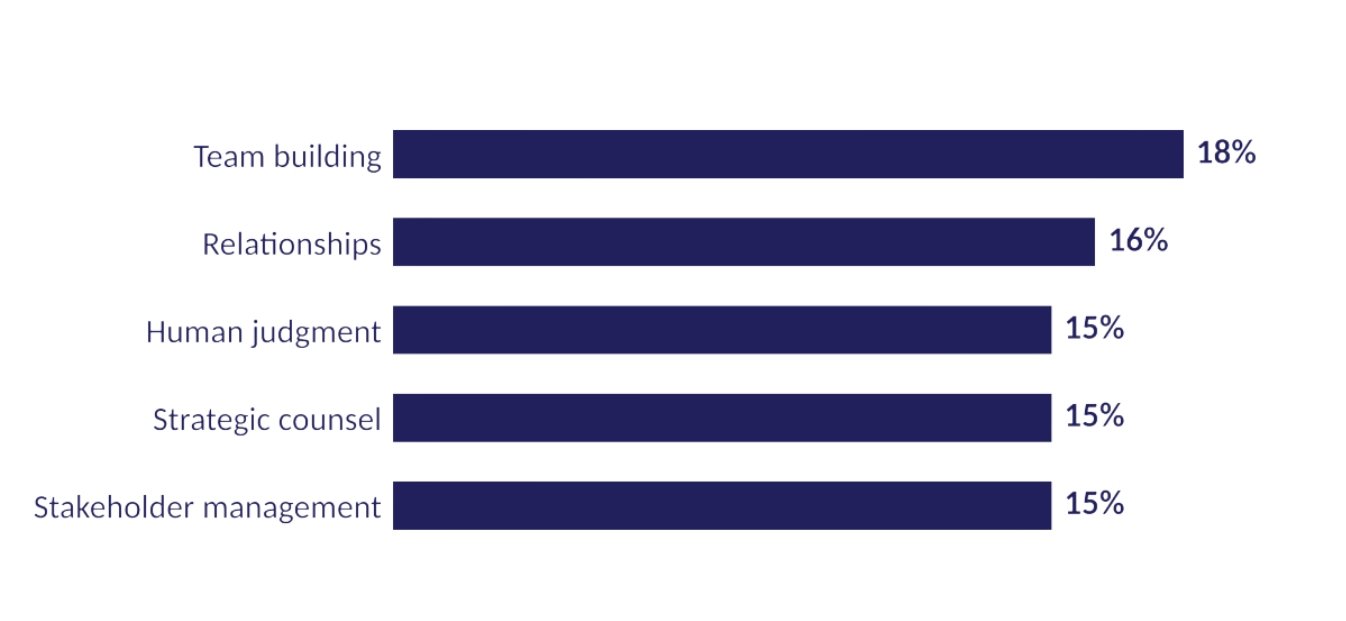
The human parts of internal communications respondents are most passionate about.
Tech leaders see the limits of automation most clearly
Tech leaders valued human judgment at more than double the average rate, suggesting that tech insiders see the limits of automation most clearly.
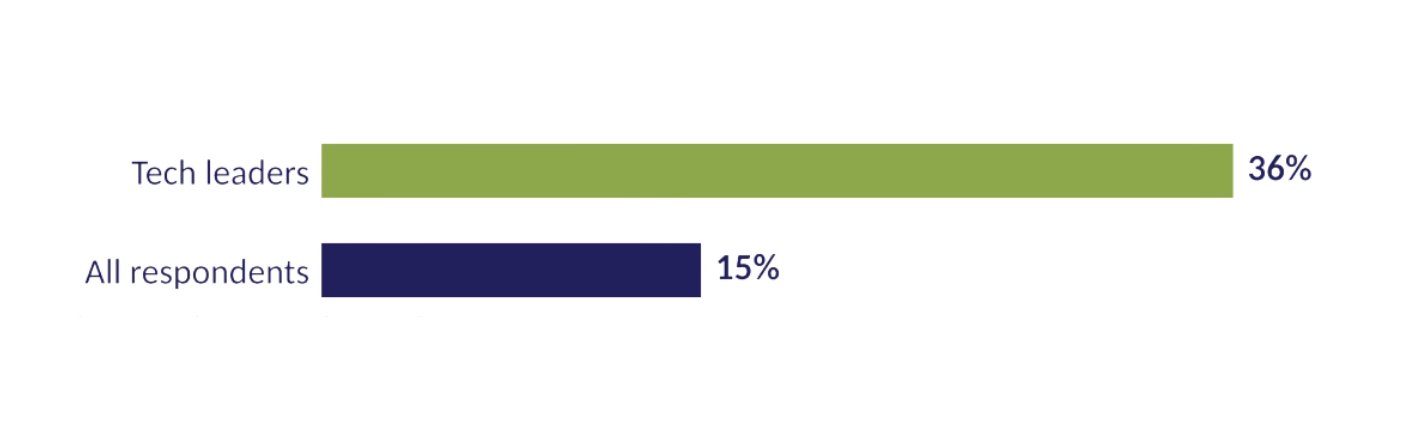
Share naming human judgment as the one thing AI can’t automate: tech leaders versus all respondents.
What communications leaders should do now
Redesign core workflows. Don’t just paste AI onto old tasks. Map entire workflows to automate or drop entirely, and explicitly keep human judgment on high-stakes decisions.
Add AI into every job. Make sure every comms person in your organization is using AI in their workflow. This is the future.
Control comms volume aggressively. Fast production leads to employee overload. Audit incoming messages, cut duplicates, and protect employee focus.
Embed comms early in business decisions. Secure direct executive access and cross-functional visibility. Communicators brought in right before launch lose all ability to shape impact.
Invest in un-automatable human skills. Train comms teams to understand business mechanics, push back constructively on execs, navigate internal politics, and build trust across units.
AI has already transformed internal communications by scaling execution. But it hasn’t replaced strategy, curiosity, or trust. Those may be the skills that matter most in the age of AI.
Methodology
The research was conducted by Censuswide among 500 U.S. Chief Communications Officers, VPs of Communications, Heads of Communications, Directors of Communications and respondents in equivalent roles. Data was collected between July 16 and August 18, 2026. Censuswide is a member of the Market Research Society and British Polling Council and a signatory of the Global Data Quality Pledge.
About Shallot Communications
Shallot Communications is a boutique communications firm that helps organizations reach the people who matter, tell compelling stories, and tackle public perception challenges. We work with companies and leaders across industries on executive communications, organizational change, public affairs, and corporate storytelling. Our team brings experience from some of the world’s most recognized organizations — pairing strategic thinking with practical, hands-on support.
Learn more at shallotcommunications.com.