
2025 Shallot Internal Communications Q4 Findings

Introduction
Shallot Communications partnered with KPS Consulting and Censuswide to ask over 500 internal communications leaders about today’s toughest challenges: when (and whether) to weigh in on social issues, how they connect with employees, how they measure impact, and what’s really driving their approach.
Earlier this year we shared findings on when—and why—companies decide to speak up on social and political issues, often driven by the connection an event has with a business’ bottom line. Now we’re digging into measurement and challenges, and here’s the headline–old school internal comms is still here, but a reckoning is upon us.
What we found
Email leads, others rise: While companies still overwhelmingly use email to communicate with employees, new channels are finally – finally! – emerging and may reduce (or replace) the inbox
Measurement is still a problem: Everyone still feels unsure about their approach to measurement and wishes they had a better way to gauge employee sentiment
Exec opinion—Party of one: Even with tens of millions (check my math!) going toward measurement tools, the oldest form of measurement–whether executives like what they see–remains a top indicator of success.
Sleeping on social: There’s a massive opening for companies to use social media to reach employees … that’s where workers are, so why aren’t organizations working to meet them there faster?
And it is about more than just evolving the strategy, it’s about training (and supporting) the communicators.
Young leaders, tough terrain: Gen Z internal comms leaders are overwhelmed. Turns out political turmoil isn’t easy on leaders overseeing conversations with employees.
It’s me. Hi. I’m (still) the problem. It’s me.
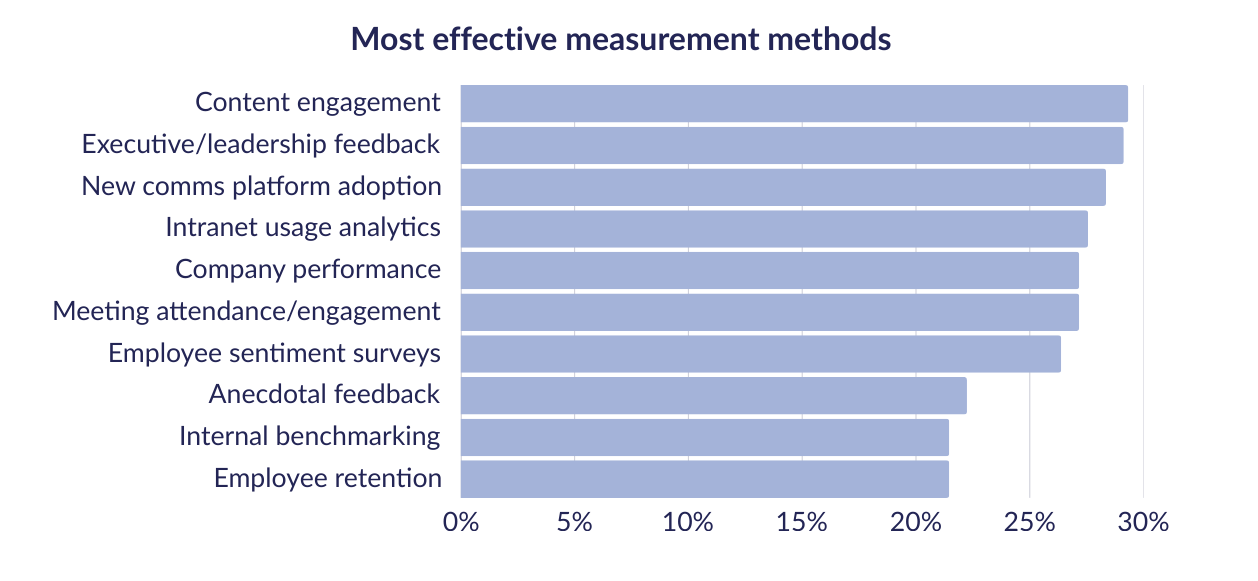
No surprise here—measurement is still everywhere and yet nowhere. We asked respondents to share their top three measurement methods and ten different options each received between 20% and 30% of the vote. With that kind of spread—and no clear front-runner—do we, as an industry, actually agree on what success looks like? Do our metrics give us the real story?
35% of respondents said more effective measurement and analytics tools would make their jobs easier.
Difficulty measuring success ranked as the fifth biggest communications challenge with 27% of the votes.
Dashboards, data, and … your exec’s gut feelings
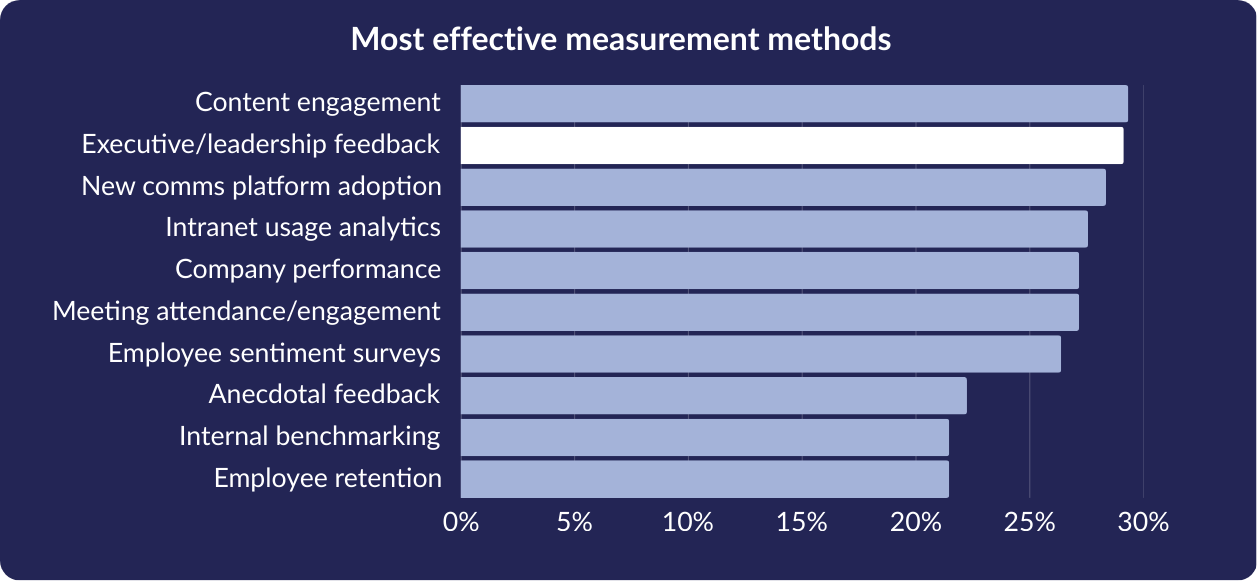
Even with more data than ever before, comms success still seems to come down to one question: “Is my exec happy?” In our survey, 29% of communications leaders ranked executive feedback as a top way to measure success—second only to content engagement by .2%. It’s a reminder that even in an era of analytics, executive feedback still shapes reality.
Comms leaders aren’t just valuing exec feedback, they are craving more of it:
25% of respondents said lack of executive buy-in is a major challenge.
28% said they wish they had better access to leadership.
Email remains king, but will it soon be dethroned?
Email remains the number one internal communications channel across deskless, remote, and hybrid/in-office employees. Even as Gen Z has a clear dislike for email, it is still the channel of choice across internal comms leaders.
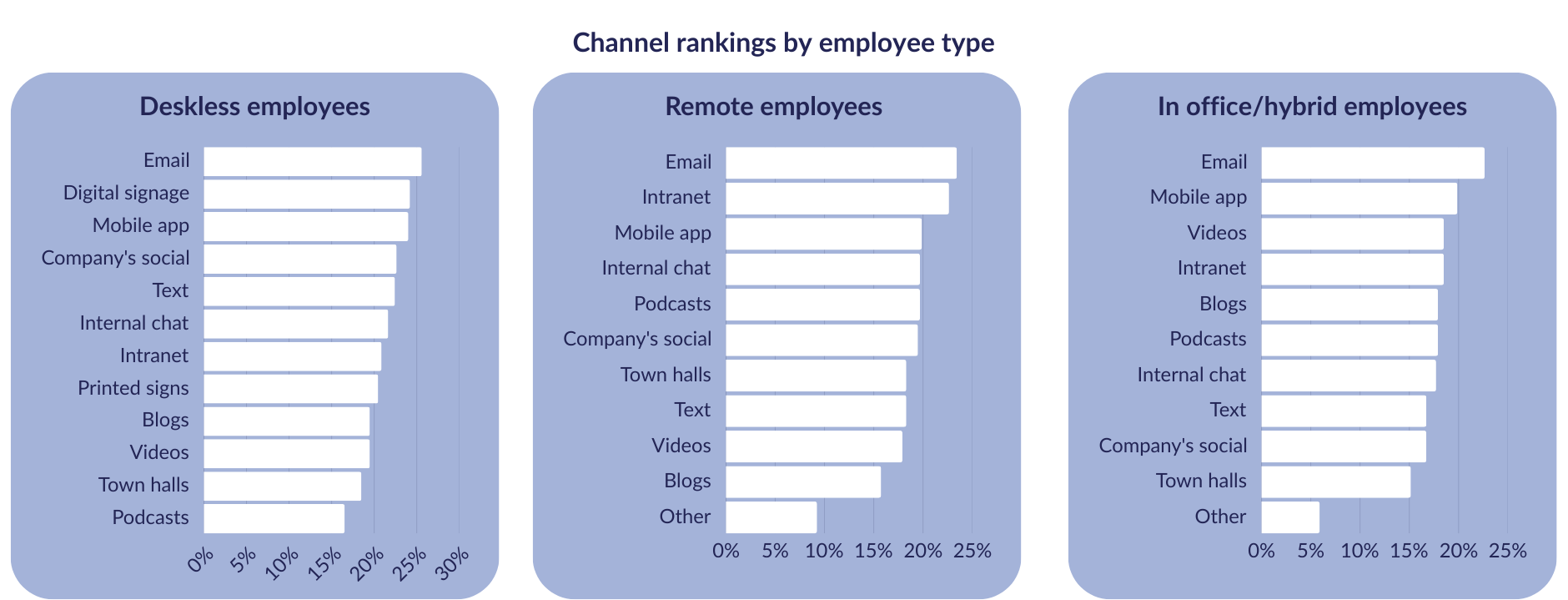
With more Gen Zers entering the workforce and Gen Alpha not far behind, we have to assume that will change. In fact, it already is for a few pockets of today’s workforce.
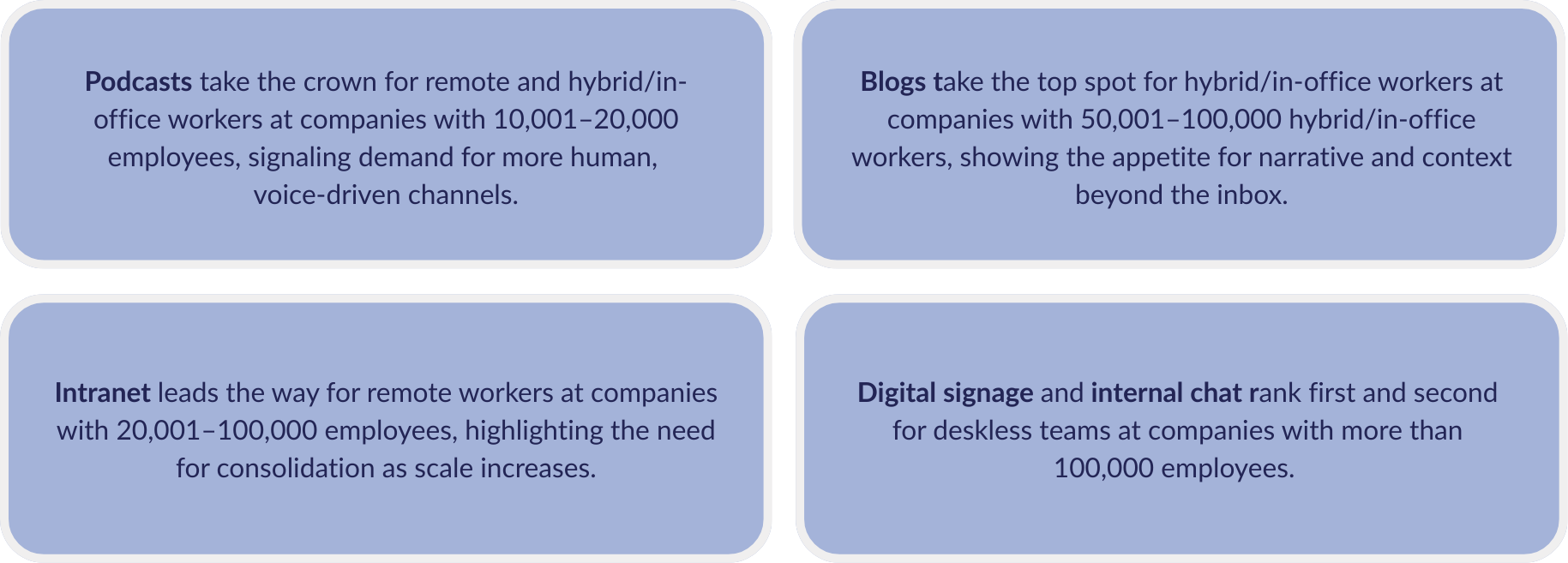
Email isn’t going away—it’s still the indispensable paper trail for alignment, accountability, and recordkeeping. But our data shows it’s no longer the universal go-to. As organizations grow and diversify, more dynamic, two-way channels—from podcasts and chat apps to social platforms and live town halls—will continue to gain ground. These channels mirror how employees already connect outside of work and how they increasingly expect to engage inside their companies.
Sleeping on social media?
Employees live on social media just as everyone else —up to seven hours per day!—so why aren’t we connecting with them there? When we asked comms leaders to share if they are using social media as a main channel to connect with employees, we found a lot of runway for new connection.

As we’ve discussed with Lauren Sanborn, Crowdstrike social media director, embracing social media as a channel for employees means elevating real voices and empowering executives and employees to speak for the brand, leaning in to messages with personality. We see Gen Z comms leaders leading the way with social media channels: podcasts (33%), internal chat (33-50%), text (17-33%), videos (17%) to incorporate native social components to connect with employees.
Are young leaders struggling to adapt?
The cohort of internal comms leaders aged 25-34 (15.9% of our survey respondents) seem to be drowning in change management fatigue like no generation before, and it’s not just because “change management” is the most corporate term around. While seasoned pros rank this challenge fourth on a list of workplace headaches, it's the number one pain point for the people who are the future of our field.
The good news is that these younger leaders aren’t trying to escape the challenges of RIFs and restructures. They just want better tools to address these challenges.

Shallot’s solutions go farther than simple tools: We equip young leaders with skills they need to adjust and adapt. Managerial training, communicating with intent, and proactive analysis of internal communications stacks help young leaders thrive despite ongoing uncertainty.
A bit more about the respondents
Shallot’s survey partners connected with 508 internal communications leaders whose experience ranged across nearly every industry and size of company, from nimble startups to Fortune 500 powerhouses. Here’s a bit more about them.
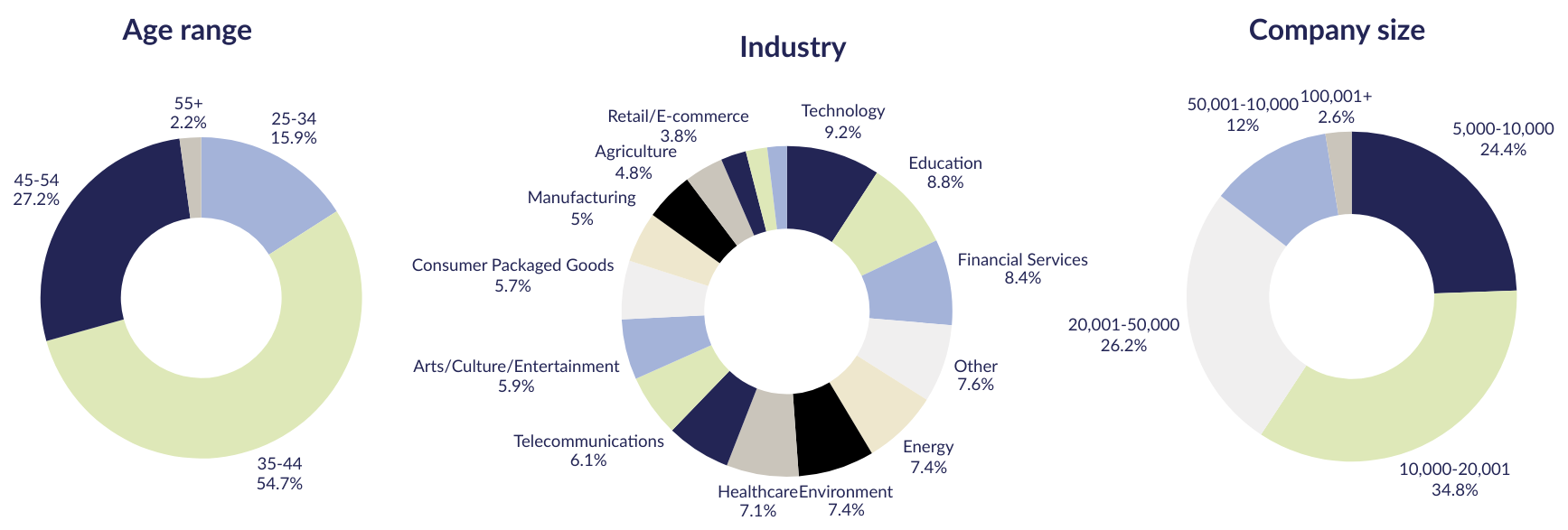
This demographic breadth allowed Shallot to identify the unique trends both expected and surprising, while tracking commonalities and shifts between generations and industries, which we will continue to follow across future internal communications surveys.
These findings have been reinforced by a series of conversations with internal communications leaders in cities across America, offering anecdotal insights that will continue to drive actionable ways for internal comms leaders to respond to the challenges they face.